

The European Strategic Energy Technology Plan (SET Plan) is a key stepping-stone to boost the transition towards a climate-neutral energy system through the development of low-carbon technologies in a fast and cost-competitive way.
The SET Plan was established in 2007 and since the creation of the energy union in 2015, it became one of the main instruments of the energy union’s 5th pillar on research, innovation and competitiveness.
By improving new technologies and bringing down their costs through coordinated national research efforts, the SET Plan helps promote cooperation among EU countries, companies and research institutions. It does so by helping to coordinate national research and innovation activities in developing low-carbon energy among EU countries and associated countries, as well as aligning national research and innovation programmes with its agenda.
Revision of the SET Plan
The Communication on the revision of the Strategic Energy Technology Plan, adopted on 20 October 2023, will help harmonise the original SET Plan strategic objectives with the European Green Deal, REPowerEU and the Green Deal Industrial Plan, notably the Net-Zero Industry Act. It will ensure a unified approach towards achieving Europe’s decarbonisation goals, supporting European strategic net-zero energy technologies, and building a sustainable and resilient energy future.
Key action areas
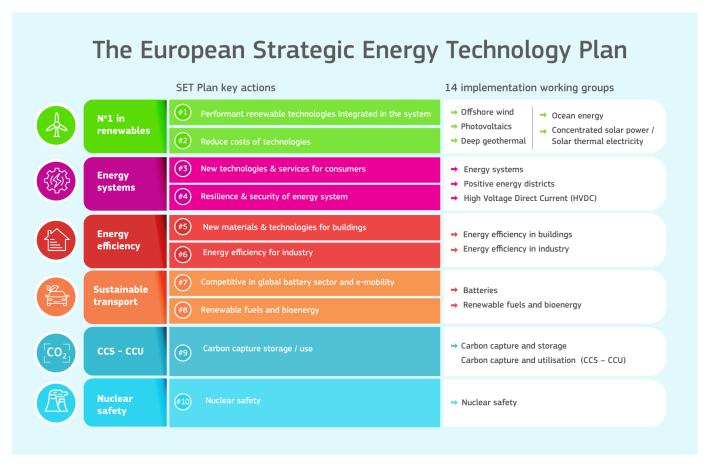
The SET Plan activities are clustered into 10 actions for research and innovation. They address the whole innovation chain, from research to market uptake, and tackle both financing and regulatory frameworks
- integrating renewable technologies in the energy systems
- reducing costs of technologies
- new technologies and services for consumers
- resilience and security of energy systems
- new materials and technologies for buildings
- energy efficiency for the industry
- competitiveness in the global battery sector and e-mobility
- renewable fuels and bioenergy
- carbon capture and storage
- nuclear safety
These actions are implemented by 14 Implementation Working Groups (IWGs), each focusing on one key technology.
Communication and monitoring
The SET Plan has several communication and monitoring tools, which are listed and described below.
The EU's SET Plan Information System (SETIS) is the open-access information, knowledge management and dissemination system for the SET Plan. It provides information on the state of low-carbon technologies. It also assesses the impact of energy technology policies, reviews the costs and benefits of various technological options, and estimates implementation costs. This information is useful for the European industrial initiatives, private companies, trade associations, the European Energy Research Alliance, international organisations, and financial institutions.
The SET Plan report is released yearly on the occasion of the SET Plan conference. The report presents the state of implementation of the SET Plan and its role in delivering the European Green Deal.
- 2023 - SET Plan Progress Report
- 2022 - SET Plan Progress Report
- 2021 - SET Plan Progress Report
- 2020 - Progress from the Implementation working groups
- 2019 - Progress from the Implementation working groups
- 2018 - SET Plan delivering results
- 2017- SET Plan – 10th anniversary report
- 2016 - Transforming the European Energy System through Innovation
The annual SET Plan conferences have been organised since 2008 and offer a chance for decision-makers, stakeholders and researchers to assess the SET Plan’s progress and the most recent developments in energy, research and innovation.
18th SET Plan conference: Scaling up research, innovation and competitiveness in clean energy technologies 14-15 November 2024
17th SET Plan conference – Energy research and innovation for a competitive Europe 13-14 November 2023
- News: The 17th SET Plan Conference - Research and Innovation for a Competitive Europe 10 November 2023
16th SET Plan conference - Towards a new Strategic Energy Technology Plan 9-10 November 2022
SET Plan countries report about their activities within the SET Plan through their National Energy and Climate Plans (NCEPs).
The SETIS reporting and IWG work feed into the yearly progress reports on competitiveness of clean energy technologies (CPR).
Governance
The SET Plan is led by the SET Plan Steering Group and Bureau. Each of the 14 IWGs establishes and regularly updates an implementation plan with specific goals for their focus technology. The IWGs are supported by European Technology and Innovation Platforms (ETIPs), the European Energy Research Alliance (EERA) and ad-hoc project support.
The SET Plan Steering Group consists of high-level representatives from the EU and associated countries. The Bureau supports its work with the preparation of internal meetings and discussions.
It ensures a better alignment between different research and innovation programmes at the EU and national levels, as well as the SET Plan priorities. It also increases cooperation between national programmes to avoid duplication and heightens the impact of public investment.
Coordination and support
European Technology and Innovation Platforms
The European Technology and Innovation Platforms (ETIPs) were created to support the implementation of the SET Plan by bringing together EU countries, industry, and researchers in key areas. They promote the market uptake of key energy technologies by pooling funding, skills, and research facilities.
Eleven out of fourteen IWGs have a corresponding ETIP:
- ETIP Wind
- ETIP PV
- Ocean Energy Europe
- ETIP Geothermal
- European Construction Technology Platform
- Smart Networks for Energy Transition
- ETIP on Renewable Heating and Cooling
- ETIP Bioenergy
- Zero Emissions Platform
- Sustainable Nuclear Energy Technology Platform
- Batteries Europe
European Energy Research Alliance
The European Energy Research Alliance (EERA) aims to accelerate new energy technology development by cooperation on pan-European programmes. It brings together more than 250 research organisations from 30 countries, involved in 18 joint programmes. EERA plays an important role in promoting coordination among energy researchers along the SET Plan objectives and in the technology transfer to the industry.
Documents
Related links
- Revision of the Strategic Energy Technology Plan (COM/2023/634)
- Publication: The Strategic Energy Technology (SET) Plan (September 2019)
- Investing in the development of low carbon technologies (SET Plan) (COM/2009/519)
- Communication - A European strategic energy technology plan (SET Plan) - Towards a low carbon future (COM/2007/723)
- SETIS - SET Plan Information System