Solar energy, in particular photovoltaics (PV), is currently the fastest growing renewable energy source in the EU. Last year, 56 GW of solar PV were installed in the EU, two thirds of it on rooftops, empowering consumers and protecting them from high electricity prices and reducing land use. The installations in 2022 and 2023 saved the equivalent of 15 billion cubic meters of Russian gas imports in total, mitigating the risk of disruption of gas supplies to the Union. In addition, the sector provides around 650 000 jobs, 90% of these on the deployment side, and is projected to increase until around 1 000 000 by 2030.
Achieving the 2030 EU target of at least 42.5% renewable energy by 2030, with an ambition to reach 45%, will require further acceleration in the deployment of renewable energy, including solar energy.
The bulk of the demand for solar modules in Europe is covered by imports from a single supplier, China, a concentration that creates short-term risks for the resilience of the value chain and long-term risks for price stability for solar panels due to dependencies on suppliers outside of Europe. Access to affordable solar modules from a diversity of sources as well as a resilient, sustainable and competitive European solar value chain are therefore necessary to achieve a deployment rate in line with the above targets while enhancing security of supply and mitigating the risk of supply chain disruptions.
However, the European solar module manufacturers have faced recently a particular challenge due to the combination of import dependency and a sharp drop in the prices of imported panels. In 2023, the solar photovoltaic sector in the EU and globally saw the prices of the panels plummet from circa 0.20 €/W to less than 0.12 €/W. This unsustainable situation is weakening the viability of existing European production and jeopardises planned investments for new manufacturing plants announced over the last 2 years. As a consequence, some European companies have either reduced their operations, announced that they would prioritise production in other international markets, in particular the U.S., or even announced their closure.
Over the last years, the EU has taken initiatives to strengthen its support to the European solar PV manufacturing sector, which includes several globally competitive companies in several steps of the value chain.
The European Solar PV Industry Alliance (ESIA), launched in December 2022 to reinforce the cooperation within industry, set itself the target of 30 GW of production capacity along the value chain, an objective considered achievable by 2030. The ESIA pipeline includes more than 20 projects, including several at multi-GW scale. The Net-Zero Industry Act (NZIA), on which a political agreement was reached in February, aims to ensure that the Union’s overall strategic net-zero technologies manufacturing capacity, including solar PV, approaches or reaches at least 40% of the annual deployment needs by 2030. The act includes concrete measures, such as accelerated permitting or market access facilitation through the use of non-price criteria in public procurement, renewable energy auctions and other support schemes.
However, further urgent action is needed in the short term to address the crisis in the European manufacturing industry.
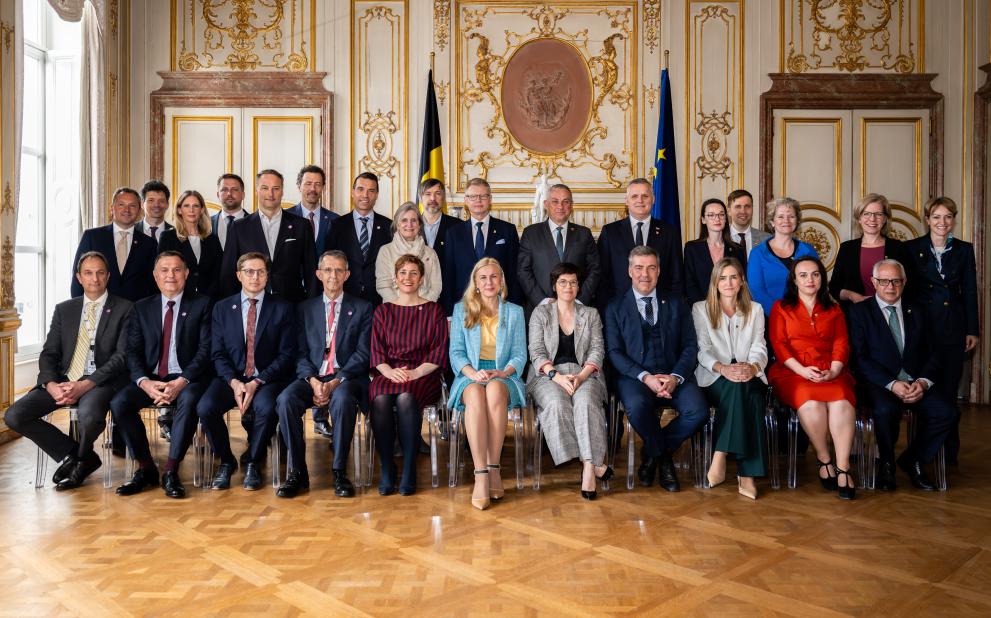
All relevant stakeholders – the Commission, the Member States and the companies active along the European solar PV value chain - should ensure that the green transition and the European industrial objectives go hand in hand, accelerating the deployment of renewables while at the same time enhancing the EU’s security of supply by supporting the competitiveness of the sector and the jobs it creates in the EU.
To this end, the European Solar Charter sets out immediate actions to be taken by the Commission, EU Member States and the representatives of the solar PV value chain, in particular wholesale, distribution and manufacturing parts, to be implemented ensuring full compliance with EU competition law and state aid rules.
Actions by EU countries and industry
The undersigning Member States and solar industry representatives, respectively COMMIT to implementing as a matter of priority the following actions:
- Promote resilient supply of high-quality sustainable solar PV products in Europe, including through:
- In the framework of renewable energy auctions or other relevant support schemes, rapid early implementation of the relevant NZIA provisions through the application of, in addition to price criteria, ambitious non-price criteria, including resilience, sustainability, responsible business conduct, ‘ability to deliver”, innovation and cybersecurity criteria.
- In the framework of public procurement of solar energy products: rapid early implementation of the relevant provisions in the NZIA and in the Energy Performance of Buildings Directive through the application of, in addition to price criteria, ambitious resilience, sustainability, social, ‘ability to deliver”, innovation or cybersecurity criteria; ensure the relevant provisions in the Foreign Subsidies Regulation are fully implemented.
- The promotion of innovative forms of solar energy deployment, such as agri-PV, floating solar, infrastructure-integrated PV, vehicle-integrated PV or building-integrated PV with a specific focus on innovative business models such as turnkey projects for PV integration in buildings, including through the removal of possible regulatory and permitting barriers as well as the adaptation of existing public support schemes or the creation of specific public support schemes.
- Create favourable framework conditions for manufacturing facilities of PV products and for additional investments, with a view to supporting the achievement of the manufacturing benchmark in the NZIA, including through rapid early implementation of relevant NZIA provisions on permitting and net-zero acceleration areas, improved availability of manufacturing skills and engagement across the value chain to improve the availability of recycled materials.
- A joint commitment across the EU solar PV value chain to continuous innovation, technological excellence, responsible business conduct, cybersecurity, sustainability, diversification of supply chains, social integration.
- Consider using all available EU funding opportunities as well as flexibilities under the State aid Temporary Crisis and Transition Framework (TCTF) to provide support for new investments in the solar energy supply chain.
- Engage in the Member States Task Force under the European Solar Industry Alliance to exchange best practices on the application of non-price criteria, provide support to the industry and to strategic projects, and on the promotion of innovative forms of solar energy deployment
- Include therefore in the portfolios of the relevant market players, such as wholesalers, distributors and installers and in view of improving the competitiveness of the Union and diversification of supplies, solar PV products commensurate to the EU’s manufacturing capacity meeting high resilience, sustainability and responsible business conduct criteria. This includes custom-made and innovative solar PV products as well as products for innovative forms of deployment (such as building-integrated PV, agri- 3 PV, floating solar, infrastructure-integrated PV or vehicle-integrated PV), provide specific visibility to key qualities and origin of these products and gradually increase their volume.
- Maintain and, where possible, expand the current production capacity, in line with expected growing demand for their products, based on the public and private commitments adopted in this Charter.
- In the case of solar PV products offtakers, incorporate resilience, sustainability, responsible business conduct, ‘ability to deliver”, innovation and cybersecurity considerations in their strategies, including through cooperation with manufacturers.
Actions by the Commission
The European Commission INTENDS to:
- Further facilitate access to EU funding for solar PV manufacturing projects under the Recovery and Resilience Facility, structural funds, the Innovation Fund, the Modernisation Fund, and Horizon Europe, including through the Strategic Technologies European Platform (STEP). The Innovation Fund has selected solar PV manufacturing projects for a total of €400 million and made €1.4 billion available in its 2023 call for clean tech manufacturing, including solar PV.
- Work with the European Investment Bank to reinforce its support to investments in the solar manufacturing value chain, including through InvestEU.
- Support Member Statesin the inclusion of transparent, non-discriminatory and objective non-price criteria in renewable energy auctions, in public procurement as well as the promotion of innovative forms of solar energy deployment, including through recommendations, guidance, and the structured dialogue in the appropriate fora, including the Community of Public Buyers for Sustainable Solar PV for public procurement.
- Explore, in cooperation with Member States through the Joint European Forum the possibility of an Important Project of Common European Interest (IPCEI) to support innovations and their first industrial deployment in the solar PV manufacturing value chain.
- Continue providing support to the European Solar PV Industry Alliance in view of the achievement of its objectives, and directly engage with Member State authorities in the dedicated taskforce to share best practices on demand-side measures and support to the sector and to strategic projects.
- Continue to cooperate with third countries to enhance the resilience and diversification of supply chains via existing and future partnerships, dialogues and trade agreements and fora.
- In collaboration with Member States and social partners, facilitate the expansion of skills availability for the EU solar sector, including for manufacturing, through inter alia the Solar Academy and the Renewable Energy Skills Partnership.
- Propose forward-looking Ecodesign and Energy Labelling regulations for solar PV products to establish, on the basis of a robust methodology, appropriate environmental and energy performance standards for the sector.
- Promote the acceleration of deployment by supporting Member States in the swift implementation of the revised Renewable Energy Directive and by implementing the Grids Action Plan.
- Assess all evidence of alleged unfair practices put forward by the industry or from other independent sources.
Monitoring and review
All signatories COMMIT to monitor future developments in the sector and contribute to a fair and competitive international environment in the solar sector.
One year following the signature of the Charter, the Commission will review the implementation of the adopted commitments.